
Criminal Court Cases in Duval County
Duval County divides criminal filings by the charge the prosecutor brings. The 229th Judicial District Court hears felonies and expunction matters. Its District Clerk preserves the cause file and issues certified dispositions. Class A and Class B misdemeanors go to the constitutional County Court, with the County Clerk as custodian. The Texas Penal Code Chapter 12 sets the offense-class punishment framework, while justice courts and Freer Municipal Court hold fine-only matters within their own jurisdiction. A searcher should identify the level of the filed charge before choosing a counter.
The clerk file is the court record. It is distinct from the Sheriff report, jail booking sheet, and DPS criminal-history entry. A prosecutor may change or decline an arrest-time allegation before filing. For that reason, the court cause and judgment provide the soundest account of what was prosecuted and how it ended. The broader Duval County criminal history overview explains how those layers connect.
The official District Clerk profile shows the local felony-record office.
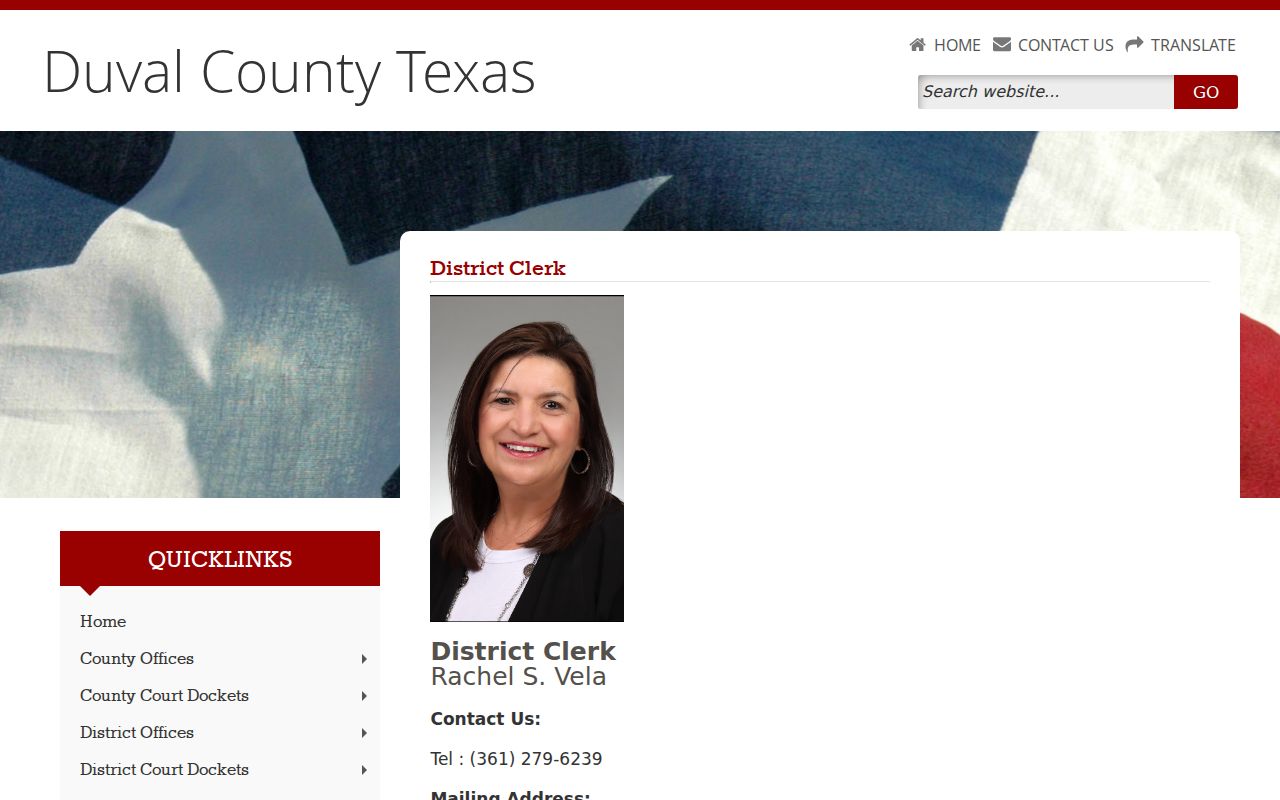
That office is the direct source for felony pleadings, judgments, and certified dispositions in Duval County.
Duval County Court Case Map
The courthouse at 400 E. Gravis Street in San Diego concentrates the main criminal courts, but it still has two distinct clerk routes. Calling the correct office saves a rejected request or a blank result.
| Court or office | Criminal work | Contact |
|---|---|---|
| 229th Judicial District Court | Felonies and expunction matters | Coordinator: 361-279-6233 |
| District Clerk | Felony files and certified dispositions | 400 E. Gravis; 361-279-6239 |
| Constitutional County Court | Class A and B misdemeanors | 400 E. Gravis; 361-279-6204 |
| County Clerk | Misdemeanor cause files | First floor; 361-279-6272 or 6274 |
| Justice and municipal courts | Fine-only cases and related warrants | Confirm the issuing precinct or city court |
The County Clerk page confirms the misdemeanor counter and its current contact details.
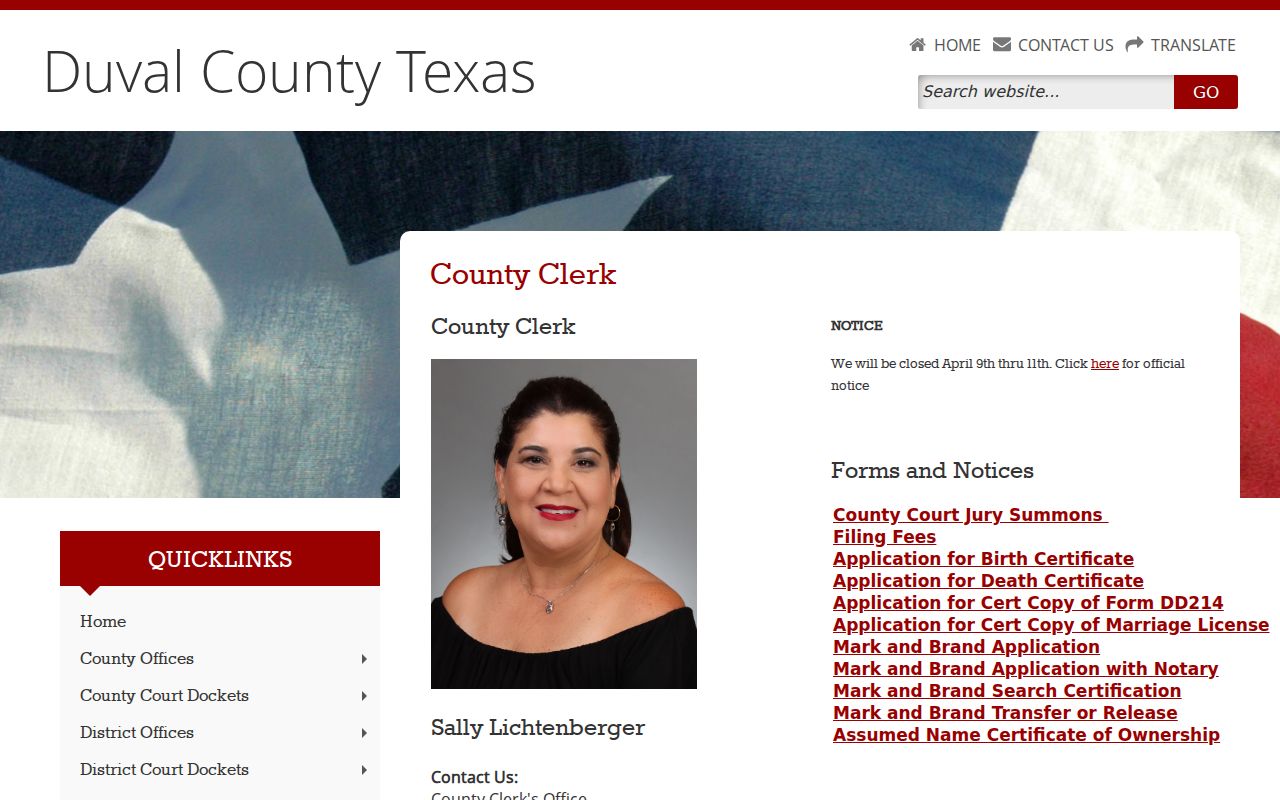
This separate clerk route is why a felony-only search cannot rule out a Duval County misdemeanor case.
The criminal-court offices do not all keep the same hours. The District Clerk and several court offices list weekday service from 8 a.m. to noon and 1 p.m. to 5 p.m.; the County Clerk lists 8 a.m. to 5 p.m. Call before a midday visit. Ask whether the cause is on site, archived, or available as an electronic image. A courthouse employee can explain access and procedure, but cannot give legal advice about the merits of a pending prosecution.
Duval County Case Record Searches
Begin with the free county calendars. They are grouped by year and setting date, not by one countywide name box. District calendars use labels such as Criminal Docket, Add-on, and Trial Docket. County calendars add regular criminal settings and some In Jail Supplements. Those files can confirm a setting or cause number, but they are not complete histories.
- Choose District Court for a felony or County Court for a Class A or B misdemeanor.
- Open the relevant year and dated calendar on the official Duval County page.
- Use a known cause number, full name, filing range, and court level to narrow the inquiry.
- Check iDocket or re:SearchTX for available metadata, while treating gaps as coverage limits.
- Ask the correct clerk for the public file, copies, or a certified disposition.
| System | Fields or controls | Access note |
|---|---|---|
| Duval docket pages | Year, setting date, docket label | Free calendars; no full name index |
| iDocket | County or court, name, cause number, date parameters | Confirm live Duval coverage and charges |
| re:SearchTX | Person or business, case, court, location, date | Registration and document access vary |
Read Duval County Docket Labels
A criminal docket is a calendar of cases set for a particular date. An add-on lists matters placed on that setting after the main calendar was prepared. A trial docket identifies cases scheduled for trial, while an In Jail Supplement highlights some set misdemeanor matters involving people in custody. None of these labels promises that every pleading or order is attached.
The Duval District Court docket index is the primary free calendar route for felony settings.
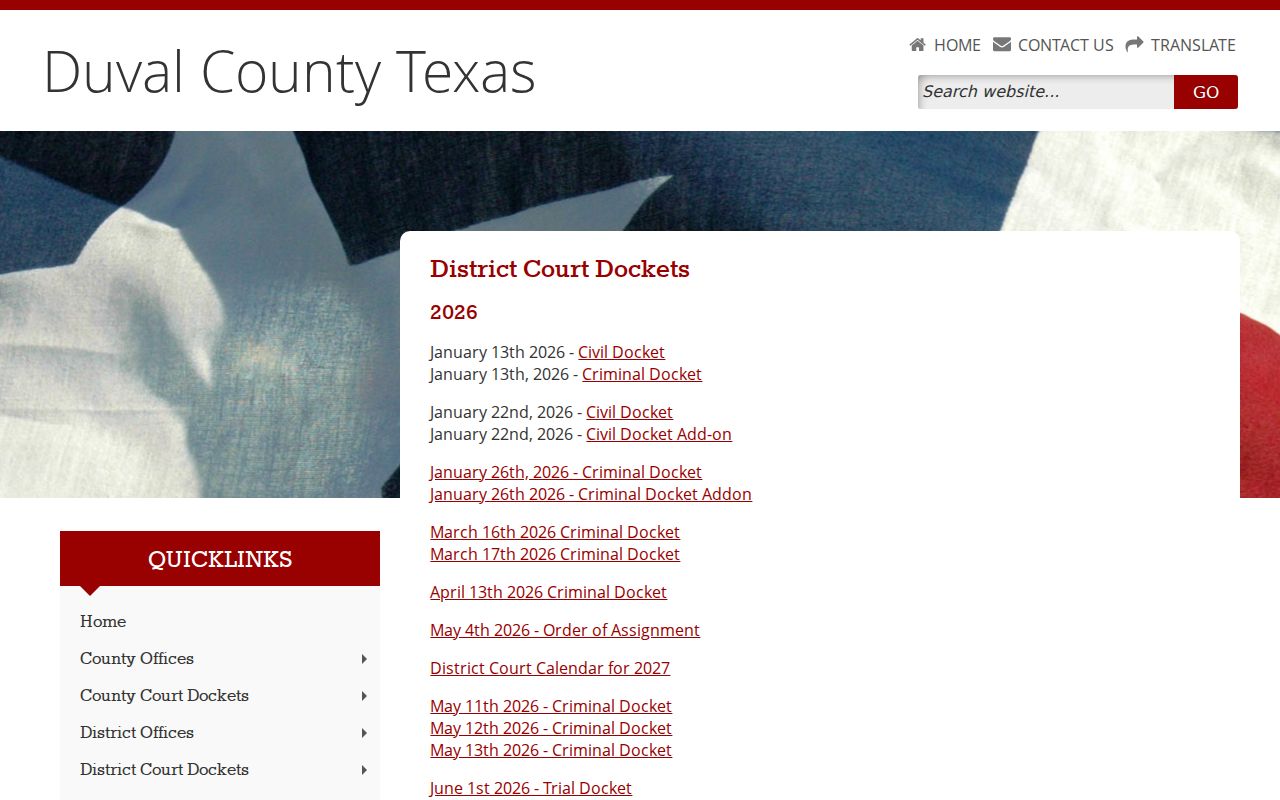
Its dated links help locate the right court and cause before requesting documents from the District Clerk.
Use the County Court docket archive for misdemeanor, add-on, and in-jail calendars.
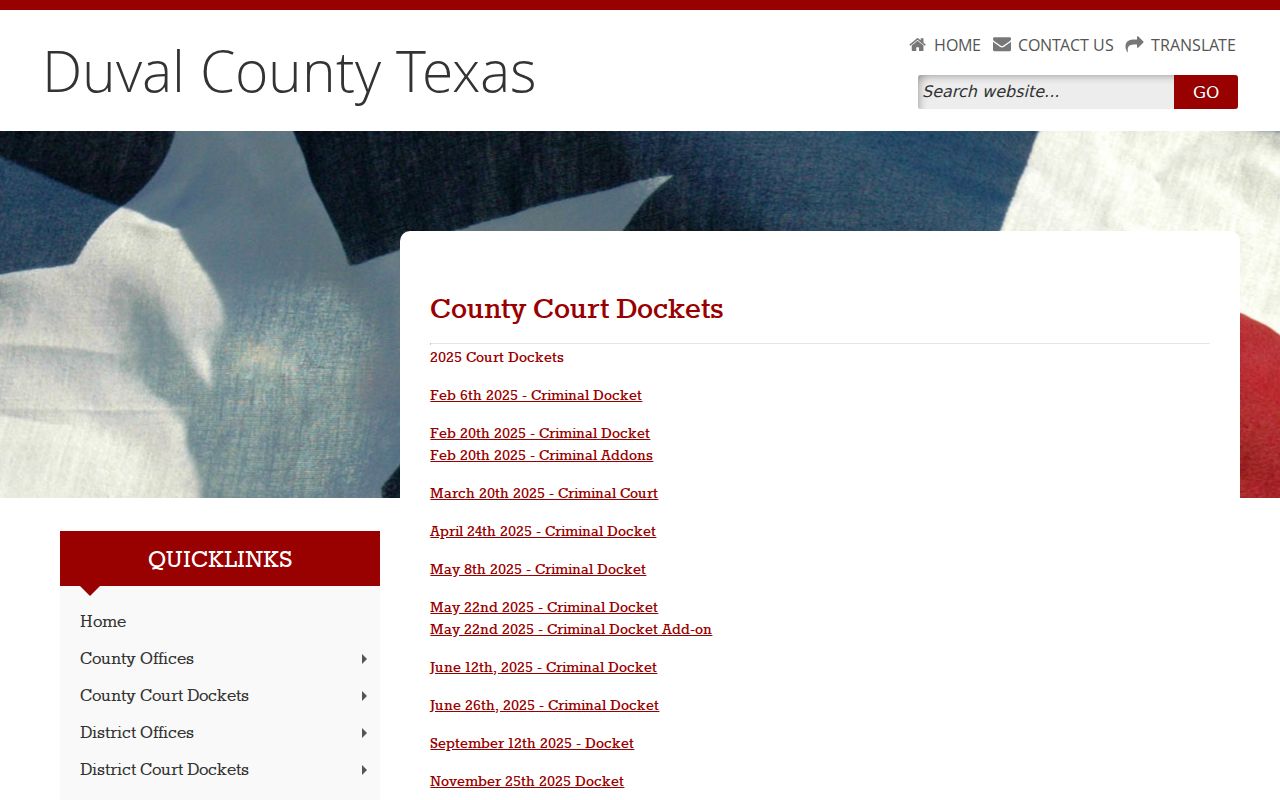
The county archive is a useful setting check, but the County Clerk still holds the complete misdemeanor case file.
What a Criminal Case File Contains
A Duval County court file can document the full prosecution after charges are filed. Ask for the docket sheet or register first, then select the papers needed. A certified disposition is especially important when a DPS record lacks the outcome because DPS requires an official court disposition for error resolution.
| Cause number and court | Identifies the filed case, court level, and local record series. |
|---|---|
| Charging instrument | The information, complaint, or indictment states the filed accusation. |
| Docket entries | Record settings, motions, orders, pleas, and other procedural events. |
| Hearing dates | Show scheduled appearances, trial settings, and later changes. |
| Disposition and judgment | Show dismissal, acquittal, plea, verdict, or deferred adjudication. |
| Sentence and conditions | State confinement, fine, costs, or community-supervision terms when public. |
Public calendars may also show the State of Texas caption, charge description, attorney, custody grouping, and add-on status. Sensitive identifiers, victim details, and juvenile material should not be expected in the public view.
Duval County Portal Coverage Gaps
Both Duval clerk pages link iDocket, and the state court system offers re:SearchTX. The Texas Office of Court Administration clerk verification also identifies iDocket for the Duval County Clerk. Neither tool guarantees every Duval County image, historic paper file, or restricted matter. Features, registration, dates, and document fees can change on the live screen. A missing result may reflect spelling, the wrong court, an older file, or a municipal case.
The clerk-linked iDocket landing page shows the remote-search option used by Duval County.

If iDocket has no useful result, call the correct clerk and ask for a manual search by name, cause number, and date range.
The statewide re:SearchTX interface provides another case-search layer.
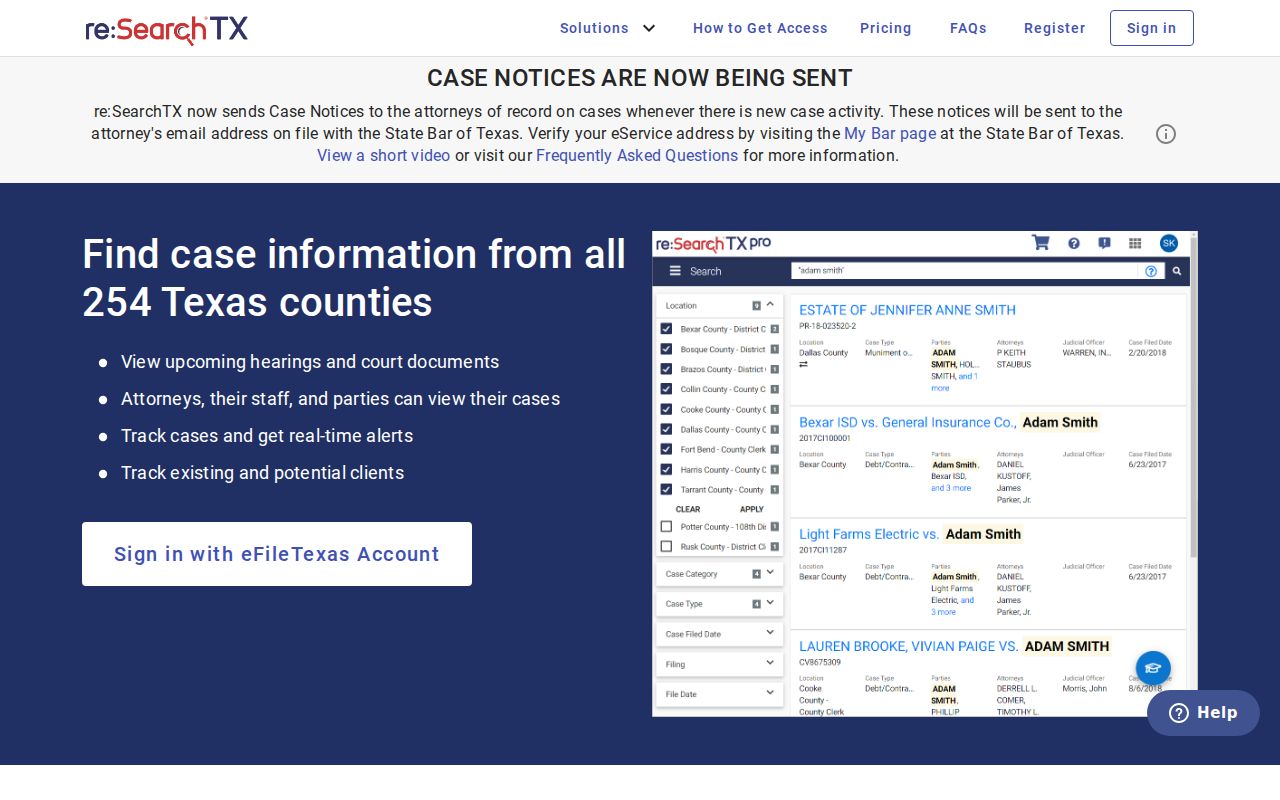
Statewide aggregation does not mean every Duval County document is present, so confirm the result against the originating clerk file.
Criminal Case Stages in Duval County
The filed prosecution begins when the proper charging paper enters the court record. Arraignment places the charge before the accused and records a plea. Pretrial events can include settings, discovery disputes, motions, and negotiated resolutions. A case may end through dismissal, plea, acquittal, or conviction after trial. The judgment and sentence then state the legal result.
Case flow: Charges Filed › Arraignment › Pretrial › Plea or Trial › Disposition › Sentencing
The docket date is not the same as a final disposition. Review later entries and the signed judgment before drawing a conclusion. Court staff may explain access and settings, but a judge cannot discuss a pending case privately with one side.
Certify a Duval County Disposition
When a public DPS result omits or misstates a Duval County outcome, identify the court that exercised jurisdiction. Request a certified disposition from the County Clerk for a misdemeanor or the District Clerk for a felony. A certified copy bears the court's official certification; an ordinary printout or calendar screenshot does not meet the same standard.
Compare the cause number, charge, disposition, and sentence before sending the certified paper through DPS Error Resolution. The clerk cannot directly edit CCH during a phone call, and DPS cannot reconstruct the local outcome from an unofficial copy. If the goal is to remove an eligible record instead of correct an error, expunction or nondisclosure is a different legal process.
A state entry may remain incomplete because the clerk report was missing or rejected. Texas CCH is designed to connect qualifying fingerprint-supported arrests with prosecutor and court outcomes, so a correct match depends on more than a name. Keep the certified paper and the DPS correspondence together. If the underlying case was in a municipal or justice court, confirm whether that lower court, rather than either Duval County clerk, is the court of jurisdiction.
Access Rules for Case Records
Texas court records are generally available through the clerk, but access is not absolute. Court rules and statutes protect identifiers, juvenile information, victim data, and records subject to sealing, expunction, or nondisclosure. An online view may omit documents that the clerk can inspect or may show a redacted version. Conversely, the fact that a docket PDF is public does not make every image in the cause unrestricted.
The Texas Public Information Act governs many agency records, yet court records also follow judicial access rules. Ask the clerk what is public, whether inspection is possible, and what copy or certification cost applies. Duval County posts a filing-fee link, but the research did not locate a current criminal-copy fee. Do not assume a price.
Access point: A sealed, expunged, juvenile, misfiled, or older paper case may not appear online. The originating clerk must confirm availability.
Duval County Case Prosecutors
The office prosecuting the case helps identify its level. The 229th Judicial District Attorney handles felony prosecutions, while the Duval County Attorney handles Class A and B misdemeanors. Both operate from the courthouse at 400 E. Gravis, but neither replaces the clerk as record custodian.
A prosecutor's office may hold internal work product or victim-assistance material that is not part of the public cause file. For pleadings, settings, judgments, and certified outcomes, use the District Clerk or County Clerk. For fine-only municipal or justice-court matters, contact the issuing court instead. This split prevents a common error: asking the District Clerk for a low-level city citation that never entered District Court.
The document ladder also keeps a request focused: start with the calendar, move to the register or docket sheet, then request the charging instrument, motions, orders, plea or verdict, judgment, sentence, and financial ledger that answer the question. Not every search needs every paper. Naming the exact item helps the clerk quote the right copy and certification terms.